What makes a UK online casino safe in 2026
 Available in GB
Current as of 23 September 2026, checked against the Gambling Commission’s public register of gambling businesses.
“Safe” in the UK online casino market is not a marketing word. It is a binary state that the Gambling Commission (UKGC) issues and a register that anyone can search. A casino is either licensed to take customers in Great Britain, or it is not — and the difference between those two states is not a finer game library, faster withdrawals or a softer welcome package. It is the entire set of player-protection rules that have piled up since 2020. Every one of them applies only to the licensed side of the line.

That distinction is the subject of this page. Ten operators sit below, all drawn from the Commission’s public register, all checked on the same day as this article. The comparison that follows treats them as licensed businesses first and as competing brands second — because the licence is the floor everything else stands on, and a feature comparison that quietly assumes everyone has one is not telling the reader much.
Table of Contents
- What “safe” means at a UK-licensed casino
- How a reader should use the public register
- What separates a regulated casino from one that only looks legitimate
- Responsible gaming at a UK-licensed casino
- The wagering cap and what 10x actually costs a player
- The comparison: ten UK-licensed operators, one snapshot
- What the ten look like, one by one
- Limits the reader should expect at every brand above
- Payments and the credit-card ban
- What a player loses by going offshore
- How to pick from the ten
- Where the data stops
- What this page is and is not
- Frequently asked questions
What “safe” means at a UK-licensed casino
A UK-licensed casino is one that the Gambling Commission has issued an operating licence to, in respect of remote (online) gambling, and that the Commission still lists as active on its public register. The register can be searched online and downloaded in full. As of the snapshot this page is built against, 139 businesses held an active remote casino operating licence. Across those 139 licence accounts sat 1,065 active domain entries and another 361 white-label entries — sites that trade under another company’s licence.

The licence is not a logo on a website footer. It is a numbered entry on a register, with a structure the reader can read for themselves. A remote casino licence number on the register has the form (account)-R-(number)-(suffix), where the leading six digits repeat the licence holder’s account number and the “R” marks a remote (online) licence. So 888casino, for example, sits under licence 039028-R-319297-014, which means account 39028 (888 UK Limited), an “R” (remote) licence, the sequence 319297, and suffix 014. The suffix is the version of that particular licence; it is not a security grade.
The reason the licence matters more than the marketing is that several pieces of consumer protection are statutory conditions of holding it. GAMSTOP, the national online self-exclusion scheme, has been a mandatory condition of every online licence since 31 March 2020. The credit-card ban for gambling has been in force since 14 April 2020. Online slots have carried a maximum stake per game cycle — £5 for players aged 25 and over from 9 April 2025, £2 for 18-24 from 21 May 2025. A licensed casino cannot run a slot spin faster than 2.5 seconds, cannot auto-play, and cannot dress up a loss as a win. Since 19 December 2025 wagering requirements have been capped at 10x, and mixed-product bonuses — bet on sport, get casino spins — are banned. None of those rules apply to an unlicensed site, because none of those rules reach an unlicensed site.
The protections are not all positive. Some are limits. A licensed casino verifies name, address and date of birth before the first deposit or any play; that requirement has been in force since 7 May 2019. Anonymous play is not possible at a licensed site. The reader who values anonymity above all else has already self-selected out of the licensed market, and no comparison on this page will put them back in. For everyone else, the ID check is the price of admission to the protections that go with it.
How a reader should use the public register
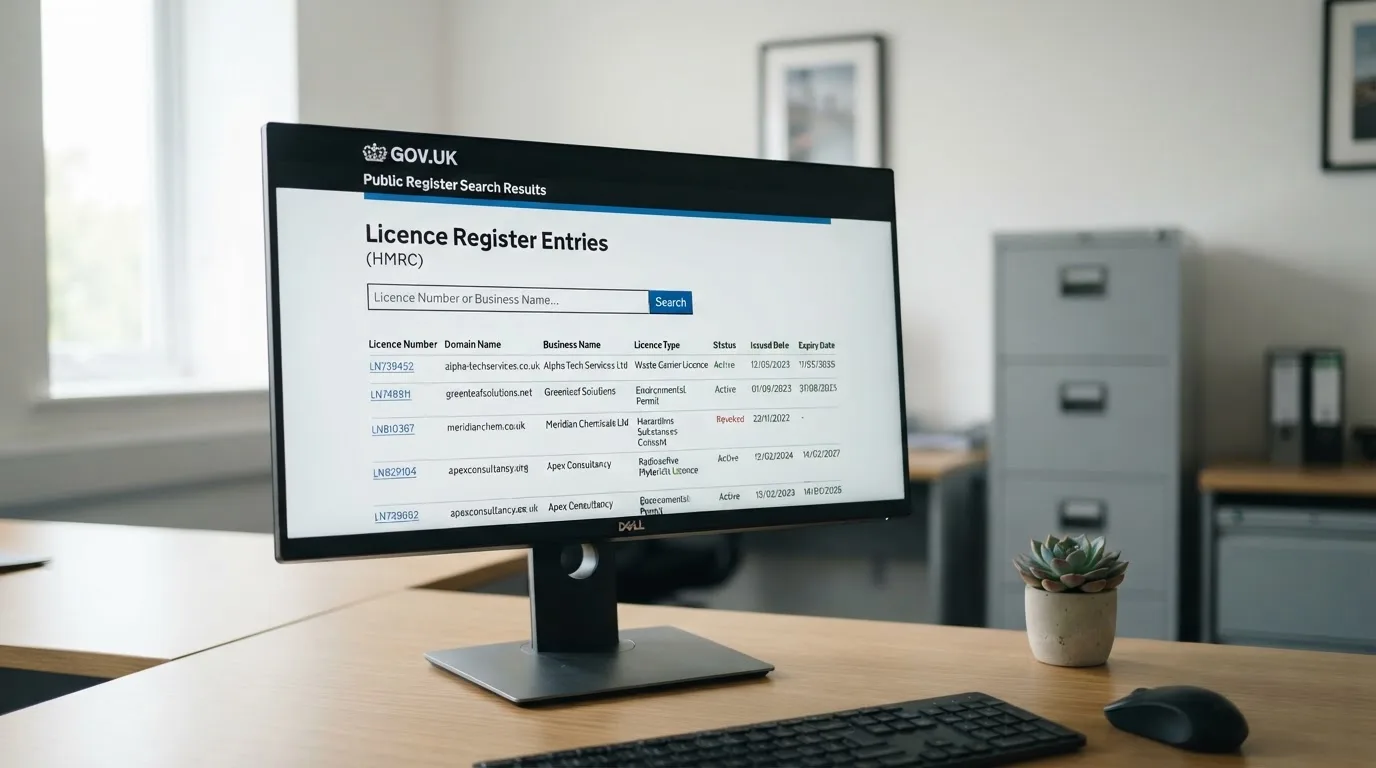
The register is at gamblingcommission.gov.uk, and it is the single source of truth for whether a brand is licensed. The reader does not need to take an operator’s word for it. They need the operator’s domain — the address the casino actually plays on — and a few seconds with the search box.
What to look for, in order:
- The domain is listed. If it is not on the register, the brand is not licensed for that domain, even if it claims to be. A second domain under the same brand is treated as a separate entry.
- The status is Active. Inactive entries were once licensed but are no longer. White-label entries are licensed, but as a customer-facing brand they are operating under another company’s licence — useful to know, and worth checking who that company is.
- The licence number starts with the account number. The account number is the holder; the licence number is the right they have been granted. Different brands under the same licensee (Ladbrokes, Coral and Gala Bingo, for example, all sit under LC International Limited) share the licence but are separate domains.
That last point matters because a customer with a problem at one LC International brand can complain to the Commission about that brand, but the corporate answer will come from the same parent. It is not a flaw of the register — it is information the register deliberately surfaces, and it is information the reader should weigh.
If a domain is not on the register, the site’s status is straightforward: it is operating illegally in Great Britain. Providing gambling to people in Great Britain without a licence is an offence under section 33 of the Gambling Act 2005. The Commission takes action against the operator — cease-and-desist notices, search-engine delisting, referrals to payment processors and hosting providers — but has no power to block the site at ISP level. The reader’s protection in that case is to leave.
What separates a regulated casino from one that only looks legitimate
The licensed-versus-unlicensed split is the coarse one. Inside the licensed set, the same rules apply to every operator — that is the point of a uniform licence regime — but how each operator interprets the rules, and the quality of the experience inside them, varies.
The pieces that vary, and that a comparison can usefully weigh:
- The licence account holder. Some holders are large, established gaming companies with a UK and European footprint; others are smaller businesses. The Commission does not endorse one over the other — both pass the fit-and-proper test — but the size of the holder tells the reader something about the operator’s likely resilience.
- The domain register entry. Active is the standard; white-label means the visible brand is trading on someone else’s licence. Both are legal. Both are different in practice.
- The offer. All licensed casinos share the same wagering cap (10x), the same credit-card ban, the same slot-stake ceiling. The headline number on a welcome offer is therefore the only variable — and a smaller headline at a known licensee can be worth more than a larger headline at a brand the reader has never heard of.
- The product focus. Some operators run a casino-heavy product (slots, table games, live dealer); others run a bingo-heavy product with casino attached; others are full-service sportsbook-and-casino hybrids. The reader who only wants slots reads a casino-heavy operator’s product differently from a hybrid’s.
- The responsible-gaming tooling. Every licensed casino has GAMSTOP integration, deposit prompts, reality checks, time-outs and self-exclusion. The quality of those tools — how visible they are, how easy they are to set, whether the casino prompts without being asked — is operator-by-operator.
The piece the comparison on this page does not do is endorsement. The Commission licenses an operator; this page describes the licence. Where one operator stands out, it is because of what the register says about them, not because this page thinks them better.
Responsible gaming at a UK-licensed casino
The reason safety in this market reads as a single concept — GAMSTOP, ID checks, deposit prompts — is that the rules are layered. Each rule is a separate instrument, and each one addresses a separate failure mode of the previous one. GAMSTOP (in force as a mandatory condition since 31 March 2020) lets a player self-exclude across every licensed online operator at once, for six months, one year or five years; it cannot be cancelled early. The 7 May 2019 identity-verification rule means a self-excluded player cannot simply open a new account at a different brand under a different name. The £150 net-deposit financial vulnerability check (in force from 28 February 2025) means an operator has a duty, on public data, to ask whether a customer whose deposits have crossed that line is showing signs of harm. The pre-deposit financial-prompt requirement (in force from 31 October 2025) means the operator has to invite the customer to set a limit before the first deposit lands.
Each rule takes a chunk of behaviour off the table. None of them takes the whole thing. A player can still gamble above their means; a player can still chase losses; a player can still play while in a frame of mind they would not, sober, have countenanced. The responsible-gaming toolset at a licensed casino is not a guarantee of safety in any single case. It is a framework, and a player who uses it gets more of it than a player who does not.
A second layer is the help on offer outside the casino. The National Gambling Helpline (run by GamCare) and GambleAware are signposted from every licensed site. GamCare offers counselling and treatment for problem gamblers in the UK; GambleAware funds research, education and treatment. None of this is operator-specific, and the Commission requires every licensee to surface it. A licensed casino that buries the GamCare link is breaking its licence conditions; a licensed casino that surfaces it is doing the minimum.
What a reader should expect from any brand reviewed here:
- GAMSTOP enrolment is one click away from the responsible-gaming page, and the casino does not require the player to be a customer first.
- The deposit-prompt comes before the first deposit, not after the second.
- The reality-check pop-up fires at the cadence the Commission requires (at least every hour of continuous play), not at a cadence the operator prefers.
- Time-outs (24 hours, 48 hours, a week, etc.) are settable without contacting customer support, and take effect immediately.
- Self-exclusion takes effect across the casino and is communicated to the operator’s central team, so the player does not receive marketing from the same brand for the duration.
None of the above is exotic. All of it is in the licence conditions. The fact that this page sets it out as a list, rather than as a feature, is the point.
The wagering cap and what 10x actually costs a player
Since 19 December 2025, every wagering requirement attached to a bonus at a UK-licensed casino has been capped at 10x. Before that cap landed, wagering multiples of 30x, 40x and 50x on the bonus amount were not unusual, and a bonus that looked generous on the marketing page worked out, in playthrough terms, to a long grind at the slots.
The cap is the simpler piece to describe. The harder piece is what 10x actually takes out of a player’s week. A worked example with round numbers makes the picture clear: a £100 bonus at the 10x cap requires £1,000 of wagering before any of it converts to withdrawable cash. At a £1 slot stake, that is 1,000 spins; at a £5 slot stake (the current maximum for a player aged 25 and over), that is 200 spins. At the Commission’s 2.5-second minimum spin interval, 200 spins is 500 seconds, or a little over eight minutes. 1,000 spins is 2,500 seconds, or roughly 42 minutes.
The same bonus at £2 (the cap for 18-24) lands in the middle: 500 spins, 1,250 seconds, or about 21 minutes of slot play. The wagering-cap arithmetic is the same for every player, but the time it actually takes depends on which stake ceiling the player’s age group sets them under, and on which stake they choose to play at within that ceiling.
The cap is not a single number the Commission picked out of the air. It is a ceiling on a marketing practice that previously let operators advertise a bonus whose real cost was buried in the small print. The reader who saw a £100 bonus at 50x wagering was, in practice, being asked to grind through £5,000 of play to release £100. The 10x cap is the Commission’s answer to that gap. It does not make bonuses free — it makes them legible. Whether the player then chooses to take one is their call.
The comparison: ten UK-licensed operators, one snapshot
The table below is a snapshot of the ten operators on this page, all checked on the same date against the Gambling Commission’s public register. Each operator is named by their primary customer-facing domain, the licence account that runs that domain, the remote casino operating licence number (with the structure described earlier in this page) and the status of the domain on the register. The comparison is not a ranking. It is what the register says about them.
| Brand | Licence holder and GB remote casino licence | Domain status on the register |
|---|---|---|
| 888casino | 888 UK Limited (account 39028); 039028-R-319297-014 | Active |
| Grosvenor Casinos | Rank Interactive (Gibraltar) Limited (account 57924); 057924-R-334666-005 | Active |
| Jackpotjoy | Gamesys Operations Limited (account 38905); 038905-R-319430-022 | Active |
| 32Red | Platinum Gaming Limited (account 45322); 045322-R-324275-019 | Active |
| Betway | Betway Limited (account 39372); 039372-R-319367-029 | Active |
| Gala Bingo | LC International Limited (account 54743); 054743-R-330863-014 | Active |
| BetVictor | BV Gaming Limited (account 39576); 039576-R-319370-028 | Active |
| Ladbrokes | LC International Limited (account 54743); 054743-R-330863-014 | Active |
| Casumo | Recro Limited (account 61549); 061549-R-336718-002 | Active |
| kwiff | Eaton Gate Gaming Limited (account 44448); 044448-R-323408-017 | Active |
A few observations sit beside the table, and they are not about who is “best”. Three operators in the set — Ladbrokes, Gala Bingo and the Coral brand that does not appear on this page — share a single licence account at LC International Limited. A reader who plays one of those brands is, for regulatory purposes, playing the same parent company as a reader who plays another. The Commission treats each domain as a separate customer-facing entry; the parent does not.
Two of the operators are run from Gibraltar: Grosvenor Casinos, under Rank Interactive (Gibraltar) Limited, and (implicitly in the same family) the wider Rank Group. The fact that a holder is Gibraltar-based does not change the licence — the licence is a GB remote licence regardless of where the holder is incorporated, and that is the deliberate effect of the Gambling (Licensing and Advertising) Act 2014, which brought every operator taking GB customers under the Commission’s remit. Recro Limited, which holds the Casumo licence, is a more recently licensed operator at the smaller end of the set, which matters because the Commission’s fit-and-proper test is the same for everyone but the consumer-facing experience at a smaller holder can differ.
Betfair (betfair.com) is on the same register under a separate licence, 039411-R-319335-010, and would normally sit in a comparison of this shape. It is referenced here for orientation only and is not in the ranked set because its product is a sportsbook-and-exchange hybrid rather than a casino-first product.
What the ten look like, one by one
888casino
888casino sits under 888 UK Limited, a long-established UK-facing gaming company that has been on the Commission’s books under the same account number (39028) since the register took its current shape. The licence number 039028-R-319297-014 reads cleanly: account 39028, remote licence, sequence 319297, suffix 014. The 888casino domain is an active entry on the register.
For a player who wants a casino-first product from a holder whose UK presence is the entire business rather than a bolt-on to a sportsbook, 888casino is the most direct fit in the set. There is nothing in the register that distinguishes it on safety grounds from any other licensed operator — the safety floor is the same for all ten — and that is the relevant comparison. Where 888casino does differ is in the depth of its casino product, which is wider than the bingo-led or sportsbook-led brands in the table.
Grosvenor Casinos
Grosvenor Casinos’ online product sits under Rank Interactive (Gibraltar) Limited, the digital arm of the Rank Group that also runs the Grosvenor land-based casino estate in the UK. The domain Grosvenor Casinos is an active register entry under licence 057924-R-334666-005.
For a reader who already knows Grosvenor from a high-street casino and wants the same name online, this is the route. The land-based estate is not a safety feature — the licence is what carries the safety — but it does tell the reader something about the holder’s UK-facing experience. The casino product is broader than the bingo-led brands; the live-dealer product is one of the deeper ones in the set, and that matters because live dealer is the place where the slot stake cap does not apply in the same way it does to RNG slots.
Jackpotjoy
Jackpotjoy sits under Gamesys Operations Limited (account 38905), with the licence number 038905-R-319430-022 and an active domain entry. The Gamesys group also runs other bingo-led brands; Jackpotjoy is the casino-and-bingo hybrid in the set, with a heavier weighting on bingo than the casino-first operators above it.
For a player who came to Jackpotjoy for bingo and stays for the casino attached to it, the casino product is competent but not the group’s flagship. The licence is the same as everyone else’s in this comparison; the product is narrower. That is a description, not a criticism.
32Red
32Red sits under Platinum Gaming Limited (account 45322), licence 045322-R-324275-019, with an active domain entry on the register. Platinum Gaming is a smaller UK-facing holder than some of the multi-brand parents in the set, and that has a real consequence for the reader: the customer is dealing with a single-brand holder, not one of several under the same parent.
32Red’s product has been casino-first since the brand’s early years, and the casino product is the deepest part of the offering. For a player who wants a focused casino experience without the sportsbook or bingo scaffolding that some of the multi-brand holders carry, 32Red is the cleanest fit in the set.
Betway
Betway sits under Betway Limited (account 39372), licence 039372-R-319367-029, active domain. Betway Limited is a UK-incorporated holder with a sportsbook-and-casino hybrid product; the casino is the smaller half of the business, not the flagship.
For a reader who already uses Betway for sports and wants the casino attached to the same wallet, that is the route. For a reader looking for the deepest casino product in the set, Betway is not it — the brand’s strength is the sportsbook, and the casino rides alongside.
Gala Bingo
Gala Bingo sits under LC International Limited (account 54743), licence 054743-R-330863-014, active domain. LC International is the multi-brand parent that also holds Ladbrokes (and Coral, outside this set). The reader who plays Gala Bingo is, for regulatory purposes, dealing with the same parent as a Ladbrokes customer.
The product is bingo-first, with a casino attached. The casino product is competent; the bingo product is the lead. A reader who wants the casino to be the headline will read this brand differently from the casino-first operators above.
BetVictor
BetVictor sits under BV Gaming Limited (account 39576), licence 039576-R-319370-028, active domain. BV Gaming is a UK-facing holder with a sportsbook-and-casino hybrid product, similar in shape to Betway but with a different commercial history. The casino is the smaller half of the business; the sportsbook is the lead.
For a reader who wants a UK-facing sportsbook holder with a casino attached, BetVictor fits that brief. The casino product is narrower than the casino-first brands above it; the safety floor is the same.
Ladbrokes
Ladbrokes sits under LC International Limited (account 54743), the same holder as Gala Bingo, with the same licence number 054743-R-330863-014 and an active domain. A Ladbrokes customer and a Gala Bingo customer are dealing with the same parent company; the Commission registers them as separate customer-facing entries, but the regulatory answer to a complaint goes to the same place.
The product is a sportsbook-and-casino hybrid with a long UK high-street history. The casino is part of the offer rather than the whole of it. For a reader who wants the casino product to be the lead, Ladbrokes reads differently from the casino-first operators above; for a reader who wants a UK high-street name online, it is the most direct fit in the set.
Casumo
Casumo sits under Recro Limited (account 61549), licence 061549-R-336718-002, active domain. Recro is a more recently licensed holder at the smaller end of the set, and the licence is newer than some of the long-standing entries in the table. The fit-and-proper test the Commission applies is the same regardless of how long the holder has been on the register; a newer holder is not a weaker holder.
Casumo’s product has been casino-first since the brand’s launch, with an adventure-style loyalty mechanic that has been part of the brand identity. For a reader who wants a casino-first product from a holder that is not one of the multi-brand parents, Casumo is a clean fit.
kwiff
kwiff sits under Eaton Gate Gaming Limited (account 44448), licence 044448-R-323408-017, active domain. Eaton Gate is a smaller UK-facing holder. The brand’s product is a sportsbook-and-casino hybrid, with a distinctive “supercharged” odds mechanic on the sports side that does not carry across to the casino.
For a reader who wants a casino product from a smaller holder, kwiff fits that brief. For a reader looking for the widest casino library in the set, kwiff is not it; the brand’s identity is the sportsbook.
Limits the reader should expect at every brand above
The rules described earlier in this page — GAMSTOP, ID checks, slot stake caps, the wagering cap, the credit-card ban — apply to all ten operators uniformly, because they are conditions of the licence. The reader does not need to check them brand by brand.
There are also limits the reader should expect that the Commission sets but does not always publicise loudly. The £150 net-deposit financial vulnerability check (in force from 28 February 2025) is one: an operator has a duty, on public data, to ask whether a customer whose deposits have crossed that line in a rolling 30-day window is showing signs of harm. The check runs against public data only — credit history, court records, the wider financial footprint — and the operator is required to act on the result, which can mean a deposit limit being set by the operator rather than by the customer. The wider financial risk assessments (using data sources beyond the public record) have been announced but are not yet in force as of the snapshot this page is built against.
The slot stake caps deserve a second mention because they bite differently at different ages. The £5 cap applies to players aged 25 and over; the £2 cap applies to players aged 18-24. The Commission set the two-tier structure on the basis that the 18-24 cohort carries a disproportionate share of problem-gambling harm. A player in the 18-24 bracket who would have played at a £5 spin is now playing at £2, which means the same wagering turnover takes 2.5 times as many spins. The arithmetic in the wagering-cap section above applies in both tiers; the time it takes changes.
There is no state-set deposit or loss ceiling at a UK-licensed casino. The pre-deposit financial-prompt requirement (in force from 31 October 2025) means the operator must invite the customer to set a financial limit before the first deposit, and the customer can decline. A customer who declines the prompt is gambling with no operator-set ceiling, and the only limit is the one the customer sets for themselves.
Payments and the credit-card ban
Since 14 April 2020, the Gambling Commission has banned the use of credit cards to fund gambling across all online and offline gambling products in Great Britain, with the narrow exception of non-remote lotteries paid for face-to-face. The ban includes credit cards routed through e-wallets — funding an e-wallet with a credit card and then funding a casino from the e-wallet is gambling on credit, and the ban reaches it.
Debit cards and bank transfers are unaffected. Apple Pay, which protects card data through tokenization (replacing the actual card number with a device-specific tokenised Device Primary Account Number and generating a dynamic security code for each transaction), works at any UK-licensed casino that accepts it as a debit-card route — and the underlying card is the debit card the wallet holds. Apple Pay in-store payments use near-field communication (NFC) to communicate with contactless terminals; that is not a feature of the online casino product, but it is the mechanism the reader has used elsewhere and is the reason Apple Pay reads as familiar.
Bank transfers within the UK typically move through the Faster Payments Service, launched in 2008 and operated by Pay.UK. The service runs 24 hours a day, seven days a week, and most payments arrive instantly or within a couple of minutes; transfers can occasionally take up to two hours. The Faster Payments scheme sets a £1,000,000 per-transaction limit, though individual banks can and do impose lower limits on their customers. A deposit that arrives instantly and a withdrawal that arrives instantly are different routes through the same scheme, and the casino side is usually the slower of the two because of internal processing.
The Commission’s estimate at the time of the credit-card ban was that around 800,000 UK consumers used credit cards to gamble in 2018, and that 22% of online gamblers who used credit cards to gamble were classed as problem gamblers. The ban is a public-health intervention aimed at that overlap. The reader who wants to deposit from a credit card, post-2020, cannot do so at a licensed casino; the only routes that work are debit cards, bank transfers and e-wallets funded from a non-credit source.
What a player loses by going offshore
The section above describes the protections. The other side of the comparison is what the player loses by gambling on a site that is not on the register.
- No GAMSTOP. A player who has self-excluded through GAMSTOP can still open an account at an unlicensed site, because the unlicensed site has no integration with the scheme.
- No Commission complaints route. A dispute with a licensed casino can be escalated to an approved ADR (alternative dispute resolution) provider and, if that fails, to the Commission. An unlicensed site offers neither.
- No credit-card ban, no 10x wagering cap, no slot stake cap, no ID check before play, no deposit prompt, no £150 vulnerability check. The site’s house rules apply, and the Commission’s conditions do not.
- No protection of funds in the event of operator insolvency. Licensed operators are required to keep customer funds in segregated accounts; unlicensed operators are not.
The Commission’s enforcement tools against unlicensed sites are cease-and-desist notices, search-engine delisting, and referrals to payment processors and hosting providers. The Commission has no power to block sites at ISP level, so a site that has been delisted today can reappear tomorrow under a new domain. The reader’s protection, in the end, is to refuse to play there.
How to pick from the ten
The comparison above does not pick a winner, because the licence is the floor and the floor is the same for all ten. What the comparison can do is set out the differences the register surfaces, so the reader can match those differences to what they actually want.
A reader who wants the deepest casino product from a holder whose UK presence is the entire business is best served by 888casino or 32Red — both casino-first brands, both single-brand holders or close to it.
A reader who wants a UK high-street name online is best served by Grosvenor Casinos or Ladbrokes — both with long UK high-street histories that translate directly into the online product.
A reader who wants a bingo-led product with a casino attached is best served by Jackpotjoy or Gala Bingo — both with bingo as the lead product and the casino as the rider.
A reader who wants a sportsbook-and-casino hybrid is best served by Betway, BetVictor, Ladbrokes or kwiff — all four with the sportsbook as the lead and the casino riding alongside. The differences between them are about the sportsbook product and the holder, not about the casino.
A reader who wants a casino-first product from a smaller, more recently licensed holder is best served by Casumo — Recro Limited is a newer entry on the register, and the brand’s identity is the casino rather than the sportsbook.
These are not endorsements. They are the shape of the set as the register shows it, with the differences the register surfaces applied to the kind of player who would weigh them.
Where the data stops
The comparison on this page is a snapshot. The register updates; the licence numbers hold; the suffix changes when a licence is renewed. A reader who comes back to this page in six months will see the same licence numbers, but the domain-status field on any given entry may have shifted between Active, Inactive and White Label.
The wagering cap, the credit-card ban, the slot stake ceilings, the £150 vulnerability check, the GAMSTOP requirement and the ID-check requirement are all licence conditions, set by the Commission and amended by Commission notice. They hold for every operator in the set; they hold until the Commission changes them.
The one number on this page that changes every time the Commission publishes a new version of its public register is the count of businesses holding an active remote casino operating licence. The snapshot on this page is 139 businesses, 1,065 active domains and 361 white-label domains, all as of 18 September 2026. A reader checking the register themselves will see a different total tomorrow, and a different total again next quarter.
The other number worth flagging is the credit-card-ban baseline. The Commission’s estimate was that 22% of online gamblers who used credit cards to gamble were classed as problem gamblers; that figure is from the Commission’s own 2018 survey, and it is the basis on which the 2020 ban was set. It is not a current prevalence figure. A current figure would have to come from a current survey, and none of the inputs to this page cite one.
The final limit is the offshore side. The Commission’s enforcement tools do not include ISP-level blocking, and an unlicensed site delisted today can reappear tomorrow. The reader’s protection is to leave; the comparison on this page does not list unlicensed sites, because the comparison is about the licensed set.
What this page is and is not
This page is a description of ten UK-licensed online casinos, drawn from the Gambling Commission’s public register on a single date, with the licence conditions that apply to all of them set out in plain language. It is not a ranking, not an endorsement, and not a place to find a bonus code.
The reader who came to this page with the question “which UK online casino is safest” already has the answer from the register itself: every one of them is licensed, and the licence is the safety floor. The differences between them are about product focus, holder structure and casino depth, and those differences are what the comparison above sets out.
The reader who came to this page with the question “is this brand I have heard of licensed” can use the table above to check the licence number against the register themselves, and the section on the register earlier in this page tells them how. The reader who came with the question “what does the licence actually buy me” can read the section on responsible gaming and the section on the wagering cap together, and the answer is the set of rules the licence carries.
The reader who came with the question “should I be gambling at all” is reading the wrong page. GamCare, the National Gambling Helpline and GambleAware are signposted from every licensed site reviewed here. The Commission requires it.
Frequently asked questions
How can I check whether a UK casino is genuinely licensed?
Search the Gambling Commission’s public register at gamblingcommission.gov.uk for the casino’s exact customer-facing domain. The domain is the address the casino actually plays on, not a parent company’s website. If the domain is on the register and the status is Active, the casino is licensed for that domain. The licence number on the register has the form (account)-R-(number)-(suffix), where the leading six digits repeat the licence holder’s account number and the “R” marks a remote (online) licence. If the domain is not on the register, the casino is not licensed to take customers in Great Britain, regardless of what the footer of its website says.
Interpreting the register for your own safety
The set of player-protection rules attached to the licence. A UK-licensed casino has GAMSTOP integration, an identity check before the first deposit or any play, a maximum slot stake of £5 (or £2 for 18-24), a wagering cap of 10x, a ban on credit-card deposits and a duty to run financial vulnerability checks at £150 net deposits in a rolling 30 days. A casino that looks legitimate but is not licensed carries none of those rules. The reader can verify the difference in one step: search the register. The register is the test.
Does a safe online casino still need to run ID checks?
Yes. Since 7 May 2019 every UK-licensed online casino has been required to verify name, address and date of birth before the first deposit or any play. The ID check is one of the conditions of the licence and one of the mechanisms that makes the rest of the protection work — a player who has self-excluded through GAMSTOP cannot simply open a new account at a different brand under a different name, because the new brand has to verify identity first. Anonymous play is not possible at a licensed site.
Is GAMSTOP compulsory for every safe UK casino?
Yes. GAMSTOP has been a mandatory condition of every UK online gambling licence since 31 March 2020. Every online casino reviewed on this page is required to integrate with GAMSTOP, and a player who has self-excluded through GAMSTOP for six months, one year or five years cannot open an account at any of them for the duration of the exclusion. The exclusion cannot be cancelled early.
Where can I search the Gambling Commission’s public register myself?
The register is at gamblingcommission.gov.uk. It can be searched online by domain or by licence holder name, and the full data set can be downloaded as CSV or Excel files. The data set covers all gambling businesses licensed by the Commission, not just online casinos. As of 18 September 2026 it held 139 businesses with an active remote casino operating licence, 1,065 active domain entries and 361 white-label domain entries.
What should I do if I suspect a casino is not actually licensed?
Do not deposit, and do not share identity documents. Check the register: if the casino’s domain is not on it, the casino is operating illegally in Great Britain and the Commission’s protections do not apply. The Commission itself takes action against unlicensed operators — cease-and-desist notices, search-engine delisting, referrals to payment processors and hosting providers — but has no power to block sites at ISP level. The reader’s protection is to leave and to raise the concern with the Commission if they wish to.
Created by the ”safecasinoguideuk” editorial team.